
Solar Panels for Kent Homes
MCS certified solar panel and battery installations for homes across Kent and the South East. We use official MCS irradiance data to size your system accurately and maximise your return, with the same technical rigour we bring to our commercial projects.
Solar sized correctly for your home
We size every domestic solar PV system using the official MCS irradiance dataset for your postcode, roof orientation and pitch: the same methodology required under MCS MIS 3002:2025. For every quote, we go further and build a 3D model of your roof as standard to accurately map shading from chimneys, trees and neighbouring buildings, specifying panel-level optimisers where they're needed to limit its effect on your system's output.
Systems usually cover 50-80% of household electricity use. Today, almost every system we design pairs a hybrid inverter with battery storage as standard, so more of that generation is actually used rather than exported.
Our team is based in Canterbury and covers Kent and the South East, including Maidstone, Tunbridge Wells, Sevenoaks, Folkestone, Ashford, Dover, Sittingbourne and Thanet.
- ✓Free home survey and design: no cost, no obligation
- ✓MCS certified installation, required for Smart Export Guarantee
- ✓3D shading model built as standard, with panel-level optimisers fitted where required
- ✓Battery storage options: Sigenergy, Tesla Powerwall, Fox ESS and more
- ✓PV-T hybrid available for homes integrating a heat pump
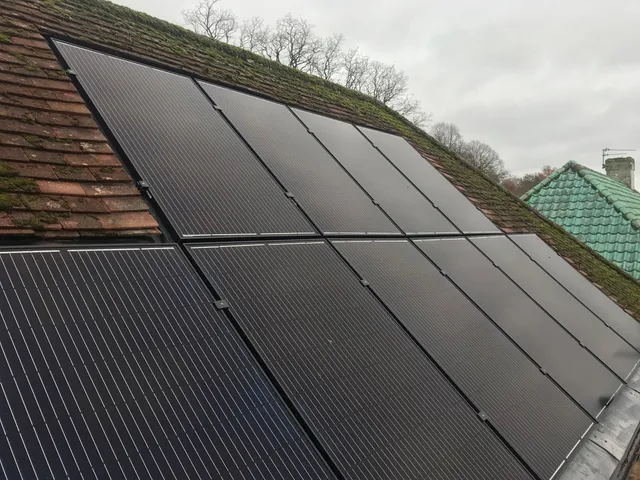
Canterbury · Maidstone · Tunbridge Wells · Sevenoaks · Folkestone · Ashford · Dover · Sittingbourne · Thanet, and the surrounding South East.
What could solar save you?
Based on a typical 4kWp south-facing system in Kent (Zone 2), at current Ofgem rates.
Get a precise estimate for your property using our free MCS-compliant calculator.
Try the solar calculator →Almost every solar PV system we design now includes a battery
A few years ago, battery storage was an optional extra. Today, falling battery prices mean it makes financial sense for most homes, so nearly all of the domestic systems we design pair a hybrid inverter with a battery as standard. A battery doesn't generate any extra electricity, but it changes how much of your own generation you actually get to use, rather than exporting it for a few pence per kWh and buying it back later at a much higher price.
Because payback varies so much from one household to the next, we don't size a battery on generic assumptions. We request your actual energy usage, ideally half-hourly data from your smart meter, and run it through a simulation alongside your solar generation, battery charge and discharge behaviour, and any time-of-use tariff you're on or considering, such as Octopus Flux, Cosy or Intelligent Octopus Go. That gives us your real self-consumption and payback for your home, not an industry average. If the numbers don't stack up, we'll tell you honestly and recommend solar without a battery instead.
- ✓Sized on your real data: half-hourly usage where available, modelled against your household loads and tariff
- ✓Smart tariff aware: time-of-use tariffs like Octopus Flux and Agile are factored into your payback, not just self-consumption
- ✓Backup power available, not automatic: standard systems disconnect in a power cut. A low-cost option gives you one socket to plug devices into directly; a full priority-circuit board costs more but keeps essential circuits, including lighting, running
- ✓Lithium iron phosphate (LFP) chemistry: the dominant, safety-focused battery technology across the ranges we install
- ✓10-year product warranty, capped at 6,000 or 10,000 cycles depending on battery, whichever comes first; the higher-cycle option suits homes that cycle their battery daily
- ✓Installed outside, not in: fire safety rules (PAS 63100) mean batteries go on an external wall, with only a few permitted positions on most homes


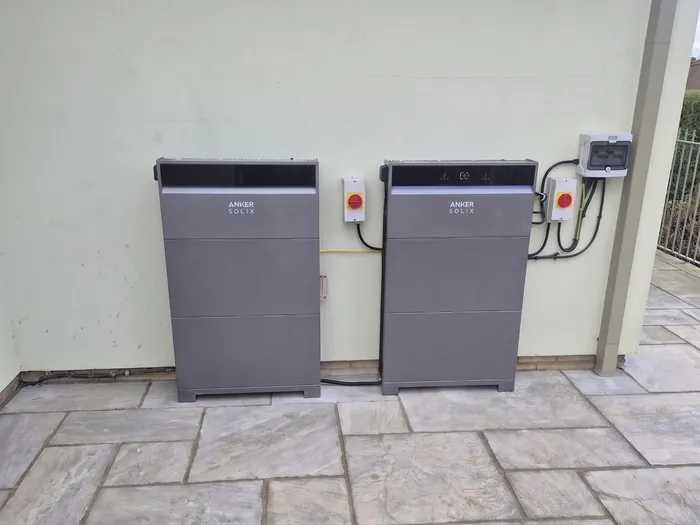
Battery storage now has its own dedicated MCS installation standard, separate from the solar standard, covering enclosure and fire safety, ventilation, structural mounting, and the same G98/G99 grid-connection testing we already carry out for solar PV. We design and commission every battery installation to this standard, whichever brand you choose.
The battery must be housed in a suitably rated, ventilated enclosure, positioned clear of escape routes and flood risk, and mounted on a surface proven to take its weight, all checked and documented as part of our commissioning process.
Customers often ask if the battery can go inside, in a garage or utility room as older systems sometimes did. As of October 2026, PAS 63100 becomes mandatory for fire safety, and this means the answer is almost always no: batteries need to sit outside, at least 1m clear of doors, windows, ventilation and escape routes, which leaves only a few workable positions on most external walls. We assess this as part of every survey.
You'll receive a full commissioning record and MCS certificate for the battery installation, alongside your solar PV certificate, and both are required if you ever need to make an insurance or warranty claim.
What our customers say
Real reviews from Google, unedited.
Domestic solar: your questions answered
How much does home solar cost in Kent?
A typical 4-6kWp domestic system costs in the region of £5,000-£9,000 fully installed, depending on panel count, roof complexity and equipment specified. Battery storage adds roughly £3,000-£8,000, though most homeowners now specify it from the outset as part of a single hybrid inverter package. Every quote is based on a free survey of your specific property.
Do I need a battery with my solar panels?
It's not compulsory, but it's now the default we design around: almost every system we install pairs a hybrid inverter with battery storage, because it typically lifts self-consumption from around 25-35% to 60-80%. Solar-only systems remain available, and we'll size either option honestly based on your usage and budget.
How long do solar batteries last?
Most batteries are designed for 10-15 years or a set number of charge cycles, whichever comes first, noticeably shorter than the 25+ year lifespan of the panels themselves, so you should expect to replace the battery at least once during your system's life. The battery's own management system monitors its health and will flag when performance has degraded.
How much can I earn from exporting electricity?
Surplus electricity is paid under the Smart Export Guarantee (SEG), with rates currently ranging from around 4p to 15p per kWh depending on supplier and tariff. We help you understand realistic export income as part of your proposal. Most of the value comes from self-consumption, not export.
Do I need planning permission for home solar in Kent?
Most homes fall under permitted development rights, so planning permission is not required. Listed buildings and some conservation areas need extra care, and we have specific experience with these across Kent and confirm the position for your property during the survey.
How accurate is your solar calculator?
Our free calculator uses the official MCS irradiance dataset (MIS 3002:2025) for your postcode, roof orientation and pitch: the same methodology a certified installer must use. It gives a genuinely accurate estimate, not a generic rule-of-thumb figure.
Ready to go solar at home?
Book a free no-obligation survey with our Canterbury-based team. We'll design a system sized correctly for your roof and usage, using official MCS data.